Local
Global
Cloud

A conversation about Dr. Albert C. Barnes and the resistance he encountered in Philadelphia to his educational and aesthetic method

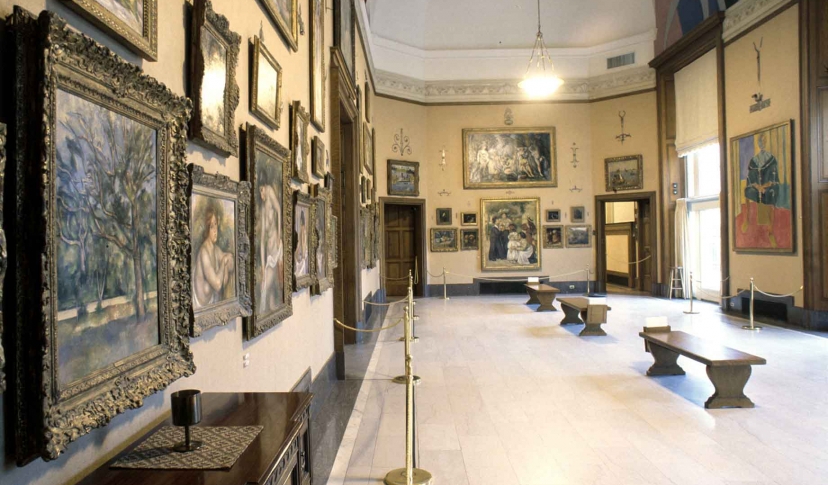
Slought is pleased to announce "Neurotic Cities: Barnes in Philadelphia," a public conversation about the history of Dr. Albert C. Barnes and the founding of The Barnes Foundation, on April 1, 2004, from 6:30-8:30pm. Presented in partnership with The Barnes Foundation, the event will consist of a presentation by Jeremy Braddock about Dr. Albert C. Barnes, followed by a conversation with Kimberly Camp, Executive Director and CEO of The Barnes Foundation.
Dr. Albert C. Barnes founded The Barnes Foundation in 1922 as an educational institution dedicated to promoting the advancement of education and the appreciation of fine arts and horticulture. Its collection consists of over 9,000 works of art by Cézanne, Renoir, Matisse, Picasso, van Gogh, Soutine, Sloan, and de Chirico, as well as fine examples of African sculpture, Asian printmaking, decorative arts and antiquities. Located in a Philadelphia suburb, The Foundation's educational program includes a multi-year track in art, aesthetics, and horticulture, employing The Foundation's 12-acre arboretum and its farm.
Albert Barnes's earliest public battles concerned both the representation of Modernist art and the popular acceptance of psychoanalysis in the United States. Occuring at a time before widespread English translation of Freud, and of the construction of either the Philadelphia Museum of Art or the Barnes Foundation, Barnes sought to establish himself as an authority on both discourses. This talk will examine his earliest battle with the University of Pennsylvania psychologists Francis X. Dercum and Charles W. Burr, and consider this context as a way of understanding the well-known public resistance to Barnes's educational and aesthetic method. In a Freudian vein, Braddock proposes interpreting Barnes's idiosyncratic system of arrangement as a "mnemotechnic in the age of the Unconscious."
Kimberly Camp was the executive director and chief executive officer of the The Barnes Foundation from 1998 to 2005. Prior to her position at The Barnes Foundation, Ms. Camp was President of the Charles H. Wright Museum of African American History (CHWMAAH) in Detroit, Michigan. From 1989-1994, Ms. Camp was the Director of The Experimental Gallery of the Smithsonian Institution in Washington, D.C., an initiative of the Office of the Assistant Secretary of Museums. Prior to that position, she was a Program Director for the Pennsylvania Council on the Arts, providing leadership in the operation and management of grants programs for educational institutions and non-profit arts organizations. An artist in her own right, Ms. Camp has been the honored recipient of numerous art and business awards including the National Endowment for the Arts Fellowship, Kellogg National Leadership Program Fellowship, Visiting Scholar for Tokyo Gedai University and The Spirit of Detroit. Born in Camden, New Jersey, Ms. Camp graduated from the University of Pittsburgh, with a Bachelor of Arts in Studio Arts and Art History. She received her Master of Science degree in Arts Administration from Drexel University in Philadelphia.
Jeremy Braddock is a Fellow at the Cornell University Society for the Humanities. He has co-edited Directed by Allen Smithee, a collection of essays about auteurism, signateurism, and the Directors Guild of America. He is presently revising a manuscript titled The Modernist Collector and Black Modernity, 1914-1934 and writing a book-length study of the Barnes Foundation.