Local
Global
Cloud

Early, reformulated and new installations by Gary Hill joining body, language and technology to form an "electronic linguistic"

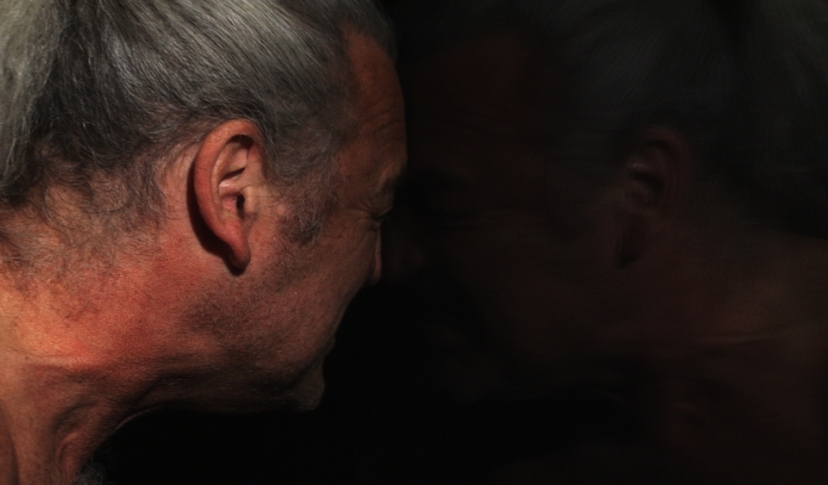
Slought is pleased to announce Art of Limina: Gary Hill. The exhibition will be on display at Slought from March 21-May 1, 2009 and is co-curated by George Quasha, Aaron Levy, and Osvaldo Romberg. The opening reception will take place on Saturday, March 21, 2009 from 6:30-8:30pm, with a public event beginning at 7pm featuring poets/artists George Quasha and Charles Stein, authors of An Art of Limina: Gary Hill's Works and Writing (Ediciones Poligrafa, 2009; with a foreword by Lynne Cooke), in conversation with the artist about their new publication, which contributes to the "further life" of the artist's work within a critical/historical context.
The exhibition at Slought is unique in that it will consist of new and reformulated installations by Gary Hill, many of which are being shown for the first time in a gallery exhibition context, and includes a rare showing of some of his early pieces. These include installations such as Wall Piece (2000), and Blind Spot (2003), and single-channel works such as Incidence of Catastrophe (1987-88). This selection foregrounds works that are less well known or understood that inform his more well known subsequent installations. This exhibition also features the world premiere of Figuring Grounds, a single-channel work which newly completes a 1985 event that Gary Hill undertook in collaboration with George Quasha and Charles Stein, and which is also featured in the publication. The exhibition also features the first showing of America of Up Against Down (2008).
The work of artist Gary Hill is defined by a sensibility of openness, complexity and subtlety of language resembling what the poet Robert Duncan called an "open universe." Since the late 1970s, he has created poetic and fantastic works that involve a simultaneity of text and image, reconceptualizing the image as a sort of semiotic construction. This new anatomy of word and image is often produced through transparency effects and electronic techniques that bypass the typical reliance on collage in the work of video artists such as Nam Jun Paik. Gary Hill's work is also notable for its conceptualist stance that emerges from a productive dialogue with technology. In his art, process, concept and method derive from the same operative principle in that the work is performative of its principle. The process is continuously emergent and open, therefore visually challenging and highly semanticized.
Already, in 1980, Gary Hill had remarked that his works constitute "a kind of electronic linguistic," suggesting that he is an artist attentive to the sound of language. Indeed, he is an artist who has discovered a direct languaging function of even highly abstract electronic processes, both in the sudden emergence of speech-like sounds and in the liminal and quasi-semiotic configuration of live imaging. Due to the rich tonalities of sounds that happened to emerge from taut wire components, he increasingly gravitated away from metal sculpture--which is how his artistic practice first began--toward electronic tools that allowed for immediate playback, dialogue with created sounds, and the phenomenon of feedback. In works such as Processual Video, which he composed by "performing" the piece at the level of text-based language, Hill made a text in dialogue with a rotating line, then later recited the text in sync with video, first as actual performance and then as single-channel video. Over the years, Gary Hill has also migrated from a non-political stance to a more confrontational position that makes newly explicit reference to contemporary issues.
Gary Hill (b. 1951; lives and works in Seattle) has been working with video and sound since 1973 and is recognized internationally as one of the more important artists of his generation. His intermedia use of text, speech and image explore the physicality of language and our thought processes. Hill creates complex installations which often solicit the viewer's active involvement to the point of "completing" the works themselves. He began his practice in 1969 when he moved to Woodstock, NY, and began studying in New York at the Art Students' League.
His early work was sculptural, but in the early 1970s he turned to audio and video, experimenting with imaging equipment and digital processing to create visual effects analogous to the appearance of abstract paintings. Much of this experimentation took place during a residency at the Experimental Television Center, Binghampton, NY (1975-7). His sculptural background continued to play a part in his video installations; for his earliest video installation, Hole in the Wall (1974), he broke a hole through a wall of the Woodstock Artists' Association, placing on the other side a monitor that replayed his destructive action. In the late 1970s he became interested in the possibilities of combining images, sound and language.
His work often makes specific literary references; Incidence of Catastrophe (1987-8), a colour video with stereo sound lasting approximately 44 minutes, was directly inspired by Maurice Blanchot's existential novel Thomas l'obscur. Here Hill appears as a free interpretation of the character Thomas, naked, engulfed and eventually overcome by language. In Between Cinema and a Hard Place (1991; Seattle, Donald Young Gallery), a three-channel video installation with 23 modified video monitors and computer-controlled video switches, Hill used a passage from Heidegger's Unterwegs zur Sprache, metaphorically describing the relation between poetry and thinking; the many monitors, stripped of their casing, display images that roll across the screens and flicker on and off, interacting in a variety of ways with the rhythm and meaning of the spoken words.
Gary Hill has been the recipient of numerous awards and honors, most notably the prestigious Leone d'Oro Prize for Sculpture at the Venice Biennale in 1995 and the John D. and Catherine T. MacArthur Foundation Grant in 1998. His work has been included in six Whitney Biennial exhibitions since 1983 and in Documenta IX, where his work Tall Ships premiered. His video, sound and performance work has been presented at museums and institutions throughout the world, including, most recently, the Reina Sofia in Madrid and the Fondation Cartier pour l'art contemporain in Paris, and in the form of projected image installations at the Coliseum and the Temple of Venus in Rome.