Cloud
Local
Global

A recorded conversation with the artist from 1958 featured in an exhibition about his work and legacy

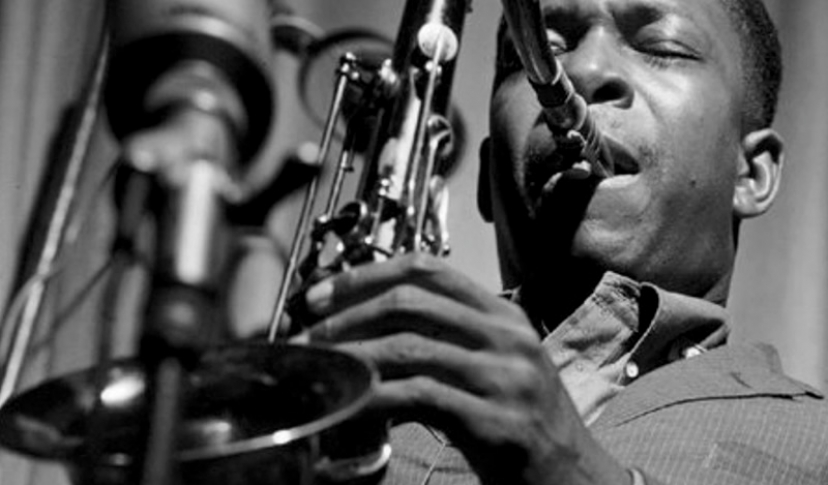
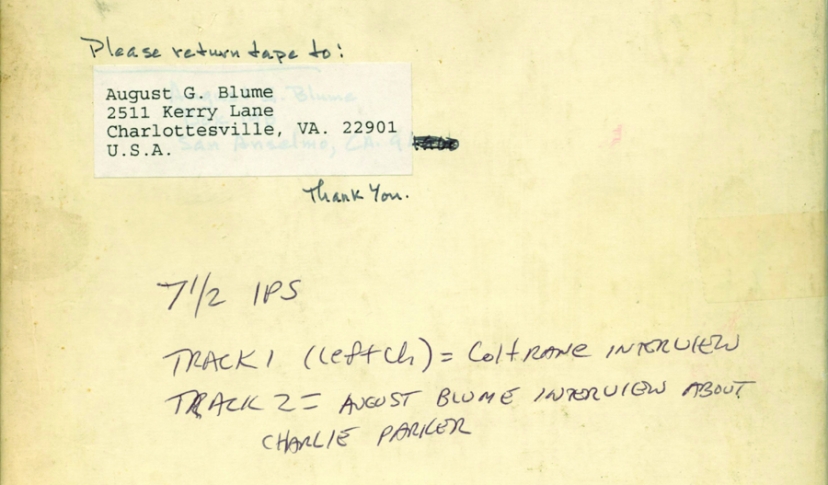
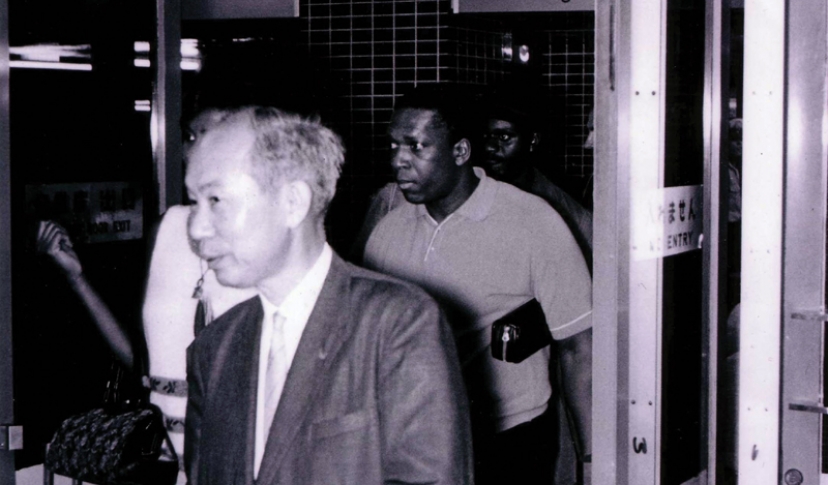
Slought is pleased to announce a recording from June 15, 1958 of John Coltrane in conversation with August Blume, in conjunction with "Coltrane", an exhibition on display from November to December 2003. The exhibition is informed by Philadelphia's rich jazz heritage and features a variety of archival materials pertaining to Coltrane's life and artistic practice (e.g. original photographs, recordings, and posters), as well as a variety of works by conceptual artists that, since the 1960s, have executed homages to Coltrane's oeuvre.
Arguably the most influential musician in modern jazz, spiritually and technically, Philadelphia's John Coltrane (1926-67) recorded for the first time under Dizzy Gillespie, before shifting from bebop towards a more open-ended experimentalism in Miles Davis's preeminent quintet which introduced modalism to his work. A brief period with Thelonius Monk in 1957 effectively signaled his career as a leader; over the next ten years his quartet - particularly with McCoy Tyner, Jimmy Garrison and Elvin Jones - evidenced Coltrane's ambitious vision.
Espousing a personalized version of Judaeo-Chistianity with elements of African and Eastern animism, John Coltrane radically shifted jazz harmony. Seminal recordings on Impulse Records include "A Love Supreme" and "Ascension," Even today, a substantial critical divide exists between Coltrane's earlier conventional, albeit highly-inventive, work and his late free-explorations.
Slought is pleased to announce a two-month exhibition and live concert series engaging the work of John Coltrane, one of the most important musicians in modern Jazz.
Philadelphia's rich jazz heritage provides an ideal backdrop for this tribute juxtaposing archival material (including August Blume's previously unreleased 1958 audio interview and listening stations featuring the live recordings, courtesy of Impulse Records) with work by contemporary visual artists that, since the 1970s, have executed homages to Coltrane's oeuvre.
Participating artists include Osvaldo Romberg, Quentin Morris, Barry Goldberg, Michael Gitlin, Uri Dotan, Doug Benson, Michael Anderson, and Stephen Pusey.
Special thanks to The African American Museum of Philadelphia, The John Cotton Dana Library / Institute of Jazz Studies at Rutgers University, Impulse Records, Larry Becker Contemporary Art, Paul Rodgers/9W, Universal Concepts Unlimited, ars nova workshop, Dave Burrell and Dan Morgenstern, and Philadelphia Weekly.
This exhibition has been organized as an homage to John Coltrane, a conceptual artist who pioneered modern jazz music. This exhibition theoretically responds to and ultimately resists Theodor Adorno's infamous writings on jazz, specifically his 1962 essay Introduction to the Sociology of Music, in which he presented jazz culture as having "the potential of a musical breakout" but ultimately becoming "a captive of the culture industry and thus of musical and social conformism."  In The Olatunji Concert (1967), his last live recording, Coltrane in fact devoted himself to and risked extreme improvisation in positing jazz as an autonomous art form. "Leaving behind," David Wild writes, "the regimented verticality of complex chord patterns, freed of the limitations of meter and chorus form, Coltrane can now work on a canvas without frames."
George Wein, in his recent autobiography examining the commercial reception of the jazz avant-garde, has argued that Coltrane hampered the development of jazz culture through excessive experimentation and inaccessibility. And Francis Davis, in discussing The Olatunji Concert, has reminded us that Coltrane's work in general was often described as "almost unlistenable." In jazz, should audience expectation in fact dictate artistic experimentation? Does our understanding of the late recordings change with time? Is our cultural predilection for formal composition limiting our ability to appreciate Coltrane's free improvisations?
The artists in this show have not been selected according to style or ideology. Rather, they have been chosen for their fraternal, and at times fanatic, addiction to jazz culture. Each one, in his own way, has been influenced by the music of John Coltrane and has in turn paid tribute to Coltrane's legacy.