Local
Global
Cloud

The second international conference/congress on architecture, philosophy, and the work of Shusaku Arakawa and Madeline Gins

Slought, the University of Pennsylvania and the Architectural Body Research Foundation, are pleased to announce Reversible Destiny - Declaration of the Right Not to Die, the Second International Arakawa + Gins: Architecture + Philosophy Conference/Congress, from April 4 - 6, 2008.
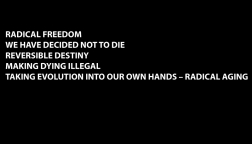
The Conference/Congress begins from the understanding that HOMO SAPIENS SAPIENS CAN TAKE ITS EVOLUTION INTO ITS OWN HANDS. Just because people seem to know more or less how to be people, going about seemingly knowing what to be up to, does not mean that they have an accurate picture of what they are or how it is that they have come to be constituted as what they are. The most advanced evolutionary and molecular biologists admit that, despite the availability to them in the early 21st century of extensive biological information databases, they know at most only between one and two percent of what contributes to and is constitutive of life, which is to say, when all is said is done, they have only the beginning of an idea as to what life - a living organism - is. The work of those who wish to achieve a reversible destiny should and will be to come up with and elucidate the remaining ninety-eight percent of what constitutes life.
Although life gets constituted and occurs on a great many scales of action at once, its pulsing composed, to be sure, on all imaginable scales, researchers have thus far been led to concentrate on only one or two scales of action at a time. Biotopology, the science of viability, has been invented to correct this situation, emphasizing, as it does, a coordinating into place of as many scales of action as possible. Reversible destiny communities will open and line up scales of action pertinent to life formation, and will, by virtue of how its architectural elements and features are positioned, speed up to an extraordinary extent the pace at which these scales of action saunter forth as distinct events inseparable from and integral to a viable whole - life as it is, in response to all we do, evolving, right under our noses, into a still even larger and more ample life, one that perhaps will not need to come to such an abrupt end.
Through this conference, thinkers from a variety of disciplines will come together to figure out how our species can achieve a reversible destiny, working in the following areas:
BIOTOPOLOGY - THE SCIENCE OF VIABILITY
TERMINOLOGICAL JUNCTIONS FOR LANDING SITE(S)
-- Landing Site/Directed Vagueness/Non-Conceptual Content
-- Landing Site/Holding Site/Reaching-For Site/Social Landing Site
LANDING SITE(S) USED THERAPEUTICALLY
HOW NOT TO DIE BY MISTAKE
GROWING THE ARCHITECTURAL BODY
-- Anti-Aging Architectural Procedures
-- Architectural Procedures for Organisms that Person - Children in Particular
Since 1963, artists-architects-poets Arakawa and Madeline Gins have worked in collaboration to produce visionary, boundary-defying art and architecture. Their seminal work, The Mechanism of Meaning, has been exhibited widely throughout the world. A sequel to that, To Not To Die, appeared in 1987. Gins and Arakawa have exhibited jointly throughout Europe, Japan, and the United States. Their exhibition, "Site of Reversible Destiny," was on view at the Guggenheim Museum Soho in December 1997 and won the College Art Association's Exhibition of the Year award.
Arakawa's large-scale paintings are in the permanent collections of museums throughout the world. Gin's published works include the avant-garde classic, What the President Will Say and Do!!, and an innovative arthistorical novel, Helen Keller or Arakawa. In 1987, as a means of financing the design and construction of works of procedural architecture that draw on The Mechanism of Meaning, extending its theoretical implications into the environment, Arakawa and Gins founded the Architectural Body Research Foundation. The Foundation actively collaborates with leading practitioners in a wide-range of disciplines including, but not limited to, experimental biology, neuroscience, quantum physics, experimental phenomenology, and medicine.
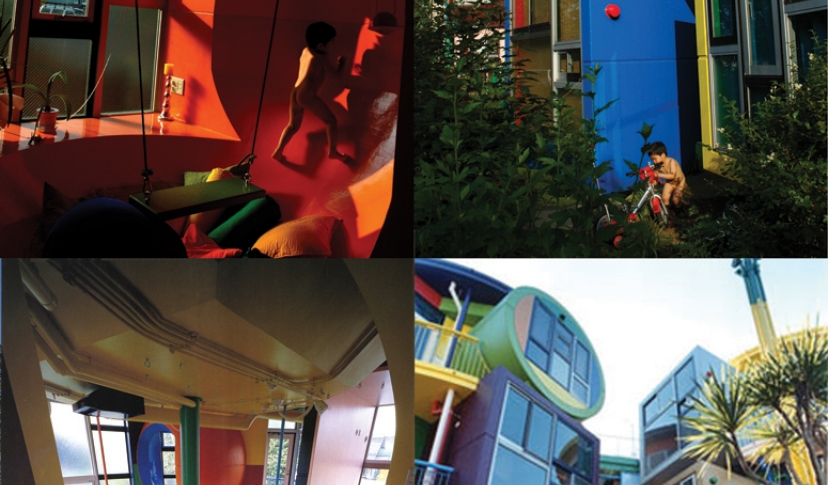
Architectural projects have included residences (Reversible Destiny Houses - Mitaka; Bioscleave House - East Hampton, Long Island; Shidami Resource Recycling Model House), parks (Site of Reversible Destiny - Yoro) and plans for housing complexes and neighborhoods (Isle of Reversible Destiny - Venice and Isle of Reversible Destiny-Fukuoka, Sensorium City, Tokyo).
The First International Conference of Arakawa and Gins: Architecture and Philosophy was held on September 30 - October 1, 2005 at the University of Paris X - Nanterre. Responding to A + G's two recent works of theory, Architectural Body (University of Alabama Press, 2002) and Making Dying Illegal (Roof Books, 2006), philosopher Jean-Jacques Lecercle declared this pair to be the successor philosophers to Marx and Engels. For more information about the Architectural Body Research Foundation, visit http://www.reversibledestiny.org/
The New York Times ("A House Not for Mere Mortals," House and Home Section; April 3, 2008):
nytimes.com/2008/04/03/garden/03destiny.html
Slought is pleased to announce READING ROOM, a special performance practice accompanying the conference. To celebrate the work of Arakawa and Madeline Gins, the READING ROOM will do more than put their books on display for the public. It will offer specially designed pointers on how to read them as what the authors call an architectural body. A series of posture- and movement-specific reading situations will be staged to help visitors sense for themselves how their activity as bodies and persons reading relates to the enigmatic action of understanding the texts. The space of the text and of thinking, so often dissociated from the space of the person doing these things, gets produced through bodily interaction with environment. By highlighting certain readerly/perceptual phenomena that make this point, the READING ROOM aims to present the texts of Arakawa and Gins in the same spirit of body-wide exploration to which the entirety of their project testifies.
Not an Arakawa & Gins information center for third-person observers, the READING ROOM will instead set up certain experiments in which the reader will simultaneously be both subject of the study and beneficiary of the findings. These situations will be on view throughout the conference, and at a special event the collaborators will be on hand to enact the featured reading experiences, walking people through them and discussing the approach used in this project, and its implications. Above all the READING ROOM provides an impetus and pretext for fruitful interdisciplinary and transdisciplinary collaboration on questions raised by the works and writings of Arakawa and Gins. The team of collaborators - organizer Jondi Keane, with Alan Prohm, Shaun Gallagher, and Theo Lotz - working together to create the READING ROOM, each coming from different fields of study, is in no way trying to duplicate the procedural architecture of Arakawa and Gins. Rather, by focusing on the texts and exploring the communal nature of devising, the aim is to build tools for embodied reading, in which landing sites and landing site configuration, key processes of body-wide attention in Arakawa and Gins' work, become self-evident and immediately fruitful as ways of registering the bodily spatial activity involved in reading.