Cloud
Local
Global

An automated multimedia installation featuring a suite of software components that allows users to generate aesthetic texts

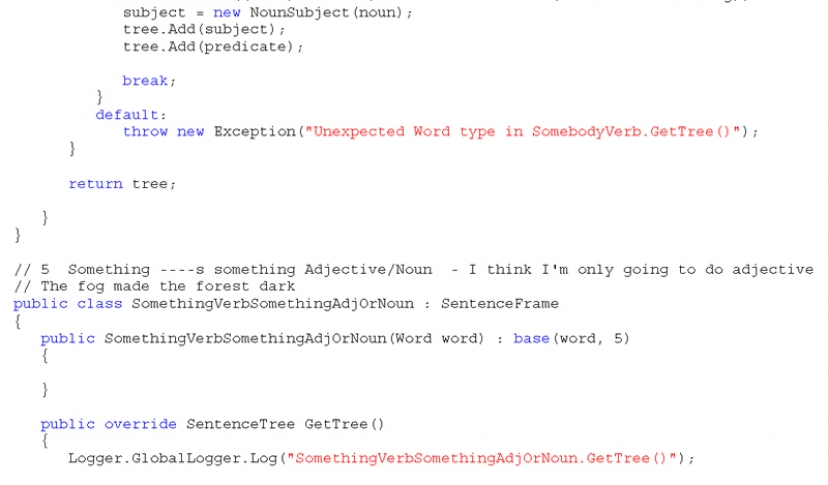
Slought is pleased to announce "Public Override Void," an installation of Jim Carpenter's Electronic Text Composition (ETC) project, on display from April 17-June 10, 2004. The project includes poetry stations and wall panels of code, including around 18,000 pages of poetry generated by three of the automated poetry stations (download the compressed files). A selection of around 2,500 pages has been randomly arranged about the vault floor; visitors are invited to walk on the poetry and, as in the preceding installation, leave with as many poems as they wish. Consider everything here public domain.
The Electronic Text Composition Project's Poetry Engine is a suite of software components that generate aesthetic texts. Drawing word associations from its language database, the Engine's grammar uses a probability-based approach to constructing syntactic constituents, which it aggregates into utterances, which it in turn aggregates into compositions. The project postulates that the construction of its texts does not actually occur within the software—these constructions, absent authorial intent and divorced from any underlying message, assume their status as poems only as they are read. The process of textual construction is firmly situated within the reader, not the software.
Over the last year a dozen poems composed with the Poetry Engine's aid and submitted under the pen name Erica T. Carter have been accepted for publication in a number of little magazines and literary journals. As evidence of the project's success (or perhaps indicative of its failure), one editor accepted a poem with the comment, "I found your works intriguing, but have to admit I couldn't wrest the meaning from them."
The installation takes its name ("Public override void") from an actual string of code embedded in the software program. An audio recording of 49 poems generated by the poetry engine and edited by Jim Carpenter has been made availabe online, as well as a textual overview of the project with extensive excerpts of code.
"Poetry Engines and Prosthetic Imaginations," a presentation and demonstration of the ETC project by Jim Carpenter (30 min), followed by a public conversation with Bob Perelman, Nick Montfort, and Jean-Michel Rabaté, will take place on Thursday, April 29, 2004 from 6:30-8:30pm.
Jim Carpenter taught English to high school students for twelve years before abandoning the profession to pursue a career in application systems development. Since then, he has held a number of technical and management positions, all in or near computational technology, and has also started and sold a company that developed applications for the election industry. He is currently an independent applications-development consultant and a lecturer in computer programming and systems design in the Department of Operations and Information Management at The Wharton School at the University of Pennsylvania.